 Home
Home
Unicompartmental Knee Replacement
A Targeted Solution for Knee Arthritis with Faster Recovery
What is a Unicompartmental (Partial) Knee Replacement?
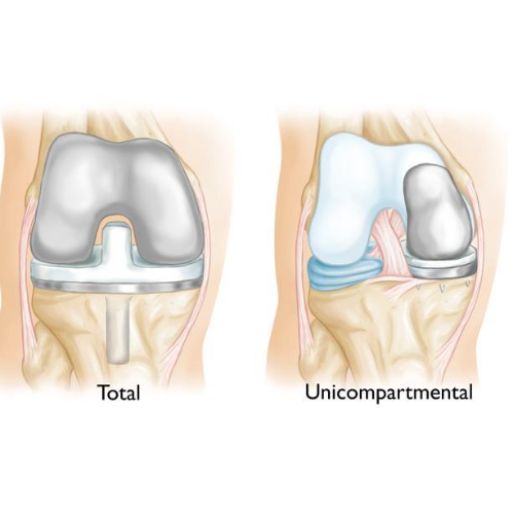
Unicompartmental or partial knee replacement is a minimally invasive surgical procedure designed for patients whose arthritis is limited to a single compartment of the knee. Instead of replacing the entire joint, only the damaged portion is resurfaced with high-quality metal and plastic components, preserving as much of your natural knee as possible.
When is a Partial Knee Replacement Recommended?
This procedure is ideal if arthritis is confined to one part of the knee, usually the medial (inner) compartment. Your doctor may recommend surgery if: ✅ Non-surgical treatments such as medications, physical therapy, and lifestyle changes have failed. ✅ You experience persistent knee pain and stiffness, especially when walking, climbing stairs, or kneeling. ✅ Your X-rays show arthritis limited to a single compartment of the knee. ✅ Your knee remains stable with healthy ligaments and cartilage in the unaffected areas.
Understanding Knee Arthritis
What Causes Arthritis?
Arthritis occurs when the protective cartilage covering the joint surfaces wears down, leading to bone-on-bone contact, pain, and stiffness. Over time, the knee may develop bony spurs and inflammation, further restricting movement. Although the exact cause is unknown, factors that contribute to arthritis include: 🔹 Previous injuries or fractures 🔹 Excess body weight 🔹 Repetitive stress from overuse 🔹 Joint infections 🔹 Inflammatory conditions (e.g., rheumatoid arthritis) 🔹 Genetic predisposition or connective tissue disorders
Symptoms of Knee Arthritis
⚠️ Pain, especially after activity ⚠️ Stiffness and swelling, limiting movement ⚠️ Grinding or clicking sensations in the knee ⚠️ Progressive difficulty in daily activities such as walking or getting up from a chair ⚠️ Changes in knee alignment (knock-knees or bow-legs)
How is Arthritis Diagnosed?
Your doctor will diagnose arthritis through: X-rays – Showing joint space narrowing, bone spurs, or other degenerative changes. Physical examination – Evaluating pain levels, mobility, and joint stability.
Unicompartmental Knee Replacement Procedure
1️⃣ Small incision – A minimally invasive approach reduces trauma to surrounding tissue. 2️⃣ Removal of damaged tissue – The diseased meniscus and a small portion of the tibial bone are removed. No bone is removed from the femur. 3️⃣ Placement of a tibial implant – A high-grade plastic component is secured to the tibia using bone cement. 4️⃣ Resurfacing of the femur – The remaining cartilage is removed, and a metal component is cemented in place. 5️⃣ Range of motion testing – The surgeon moves the knee to ensure proper function. 6️⃣ Closure – The incision is closed with sutures, and a sterile dressing is applied.
Advantages of Unicompartmental Knee Replacement vs. Total Knee Replacement
This procedure offers significant benefits over a full knee replacement, including: ✔️ Smaller incision – Less tissue disruption and a more cosmetic result. ✔️ Minimal blood loss – Reduced surgical impact. ✔️ Faster recovery – Most patients walk with support the same day. ✔️ Less post-operative pain – Quicker return to daily activities. ✔️ Better knee function – More natural feel and range of motion. ✔️ Lower complication rate – Studies show that the risk of major post-operative complications is 50% lower than with total knee replacement.
Recovery & Postoperative Care
📅 Hospital Stay: Typically 1–2 days, with some patients discharged the same day. 🩹 Walking: Full weight-bearing with crutches from day 1; most patients use crutches for about 2 weeks. 🏋️ Rehabilitation: A structured physical therapy program for 4–6 months to restore strength and mobility. 🚴 Recommended Activities: Walking, swimming, and cycling are encouraged, but high-impact activities like jogging should be avoided.
Potential Risks & Complications
While unicompartmental knee replacement is a safe and effective procedure, some risks include: ⚠️ Knee stiffness – Can be managed with rehabilitation. ⚠️ Infection – Rare, but may require antibiotics or further intervention. ⚠️ Blood clots (Deep Vein Thrombosis – DVT) – Preventable with movement and medication. ⚠️ Nerve or blood vessel damage – Uncommon but possible. ⚠️ Implant loosening over time – Proper post-op care can extend implant longevity.
Is a Unicompartmental Knee Replacement Right for You?
If you are struggling with localized knee arthritis and want a faster, less invasive solution with a natural feel, a unicompartmental knee replacement may be the best option for you.